


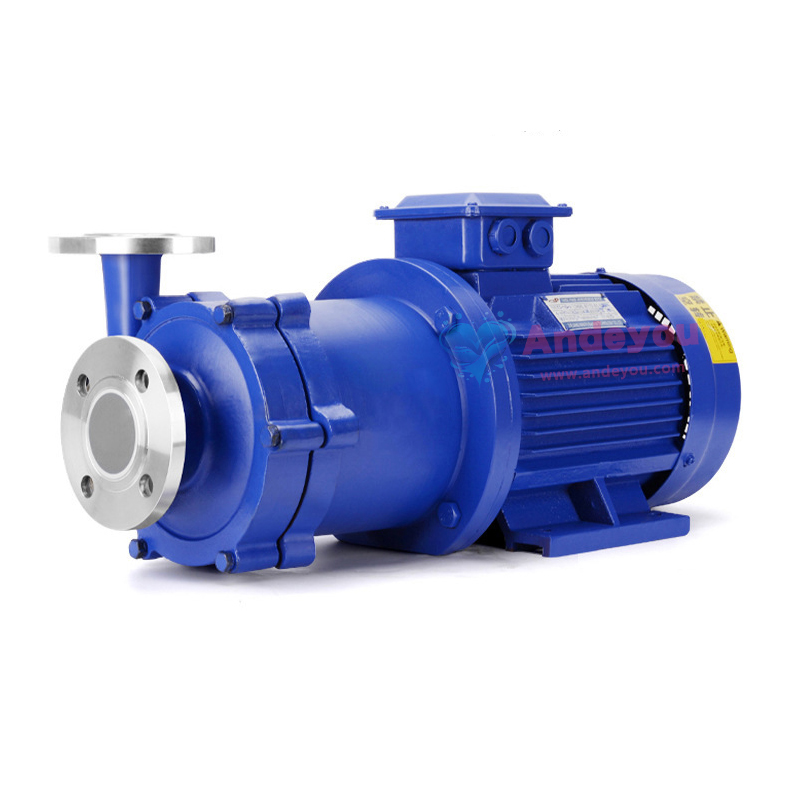
I. Core Technical Principles
1. Permanent Magnet Coupling Transmission Technology
2. Utilizes rare-earth permanent magnet materials (or ferrite magnets) to achieve synchronous rotation between the inner and outer magnetic rotors; torque is transmitted via a magnetic field penetrating a non-magnetic isolation sleeve, converting dynamic sealing into static sealing and completely eliminating leakage issues common in traditional mechanical seal pumps. The isolation sleeve is made of high-resistivity non-metallic material to effectively reduce eddy current losses, achieving a transmission efficiency of over 85%.
3. Fully Enclosed, Leak-Free Structure
4. Wetted parts (pump casing, impeller, isolation sleeve, etc.) are constructed from 304/316L stainless steel or special alloys; the enclosed static seal design ensures zero-leakage transport of flammable, explosive, and toxic media.
II. Core Performance Advantages
1. Safety and Reliability
● Completely eliminates leakage, spillage, and dripping; complies with explosion-proof requirements in the chemical industry.
● Sliding bearings utilize highly wear-resistant graphite or PTFE materials and support dry-run protection.
● Low operating noise (below 60 dB) and minimal vibration; service life extends up to 20,000 hours.
2. High-Efficiency, Energy-Saving Design
● Optimized impeller hydraulic model increases efficiency by 15%–20% compared to traditional pumps.
● Eliminates the need for independent lubrication or cooling water systems, reducing energy consumption by 30%.
● Flow rate range of 5–200 m³/h and maximum head of 80 m; adaptable to various operating conditions.
III. Structural Design Highlights
1. Modular Maintenance
● Direct-coupled back-pull-out structure allows for the replacement of wear parts without dismantling pipelines.
● Quick-release design for major components reduces maintenance time by 50%.
2. Intelligent Adaptability
● Optional variable-frequency drive (VFD) motor allows for precise flow rate adjustment.
● Supports safety monitoring accessories such as temperature sensors and pressure gauges.
IV. Typical Application Scenarios
1. Chemical Industry
● Transport of highly corrosive media such as sulfuric acid, hydrochloric acid, and hydrofluoric acid; suitable for pickling, electroplating, and pesticide production.
2. Environmental Protection and Pharmaceuticals
● Transfer of corrosive liquids in wastewater treatment systems
● Transport of high-purity pharmaceutical fluids under GMP standards
3. Special Operating Conditions
● Flammable and explosive media: e.g., organic solvents such as acetone and ethanol
● High-temperature media: High-temperature versions can withstand continuous operation at 120°C