


As more and more users opt for air-source heating systems—which are relatively energy-efficient and cost-effective—many prospective users are unsure how to select the right air-source equipment and circulation pumps.
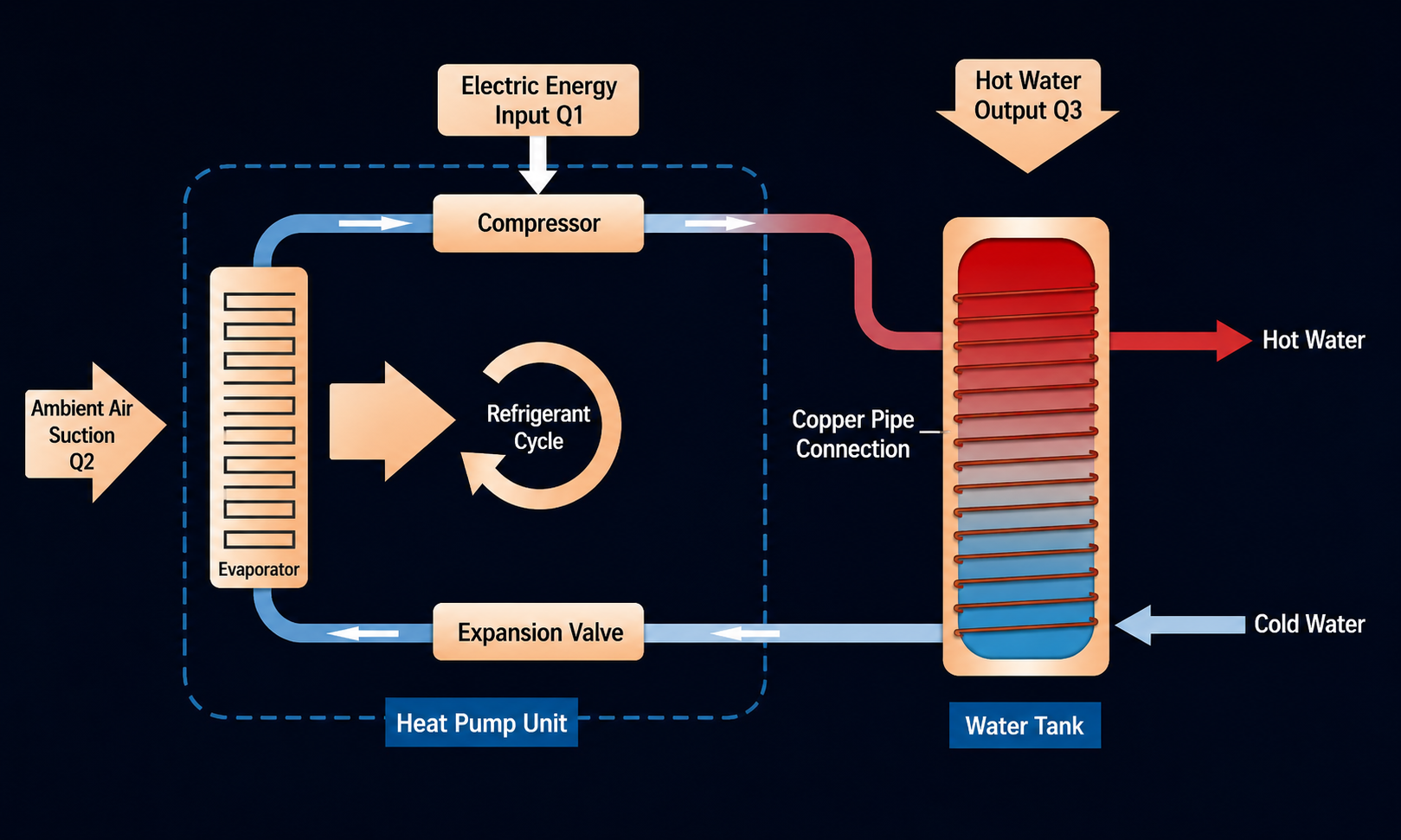
Don't worry if the image isn't clear. To put it in plain language: it works by absorbing heat from the air and transferring it to water for heating.
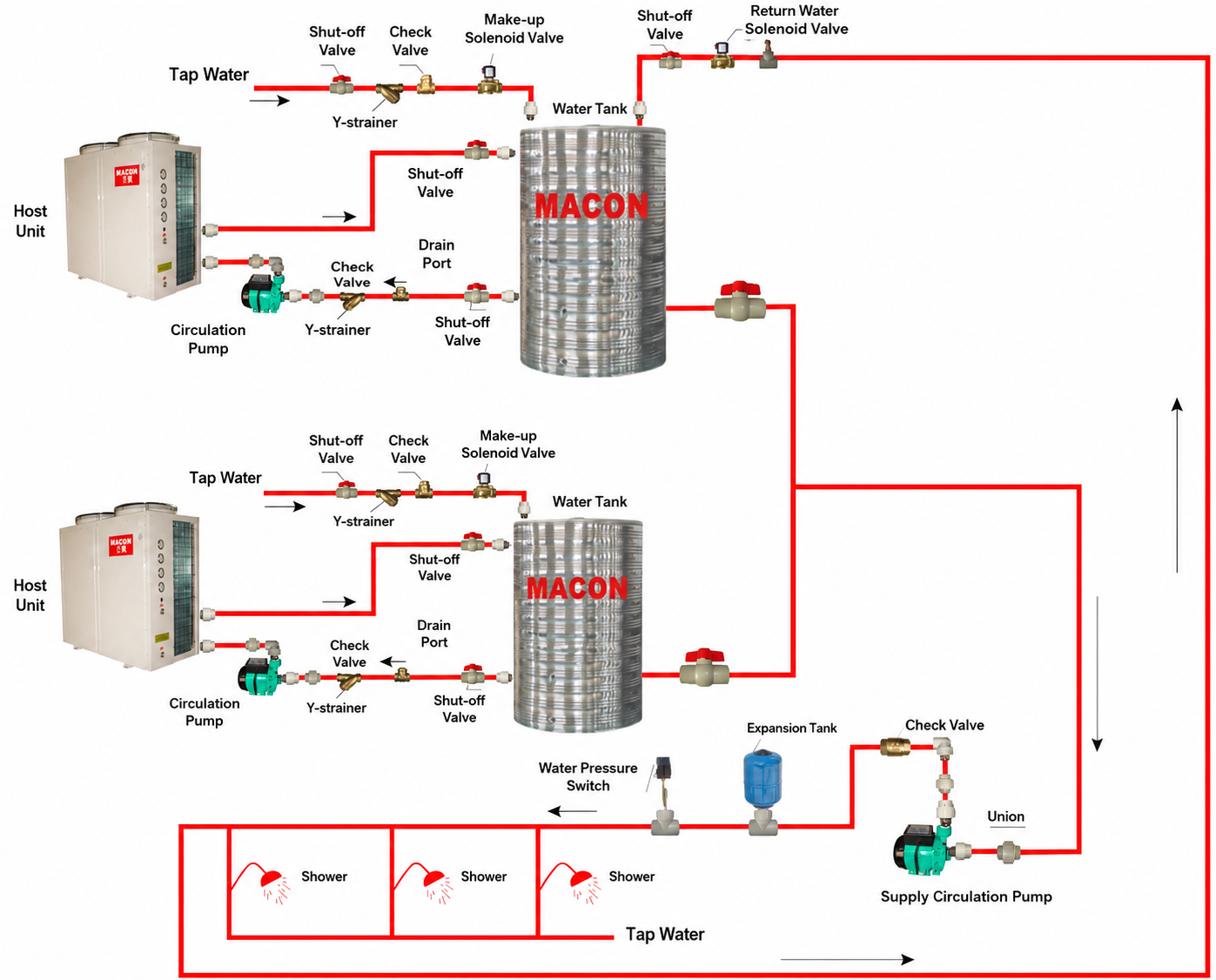
Don't worry if the diagram isn't immediately clear. To put it in plain language: tap water enters an insulated storage tank. If the water is cold, it flows into the air-source heat pump unit to be heated; once converted to hot water, it circulates through the piping in your home before returning to the storage tank. This cycle repeats continuously.
Having briefly explained how air-source heat pumps work, let’s discuss how to select the right size for the unit and the water pump. A simple, rough calculation is sufficient, given that products on the market vary—some exceed standard specifications, some fall short, and others meet them exactly.
Let’s use the "HP" (horsepower) rating as a reference, since people often ask, "For a home of *xxx* square meters, what HP rating should I choose for my air conditioner—or air-source heat pump?"
As a general rule, a heating unit rated at 1 HP can service an area of approximately 15 to 30 square meters; for most estimates, you can calculate based on 1 HP covering 20 square meters. 1. A 3-HP air-source heat pump heating unit covers an area of 45–90 m²;
2. A 5-HP air-source heat pump heating unit covers an area of 75–150 m²;
3. A 6-HP air-source heat pump heating unit covers an area of 90–120 m²;
4. A 7-HP air-source heat pump heating unit covers an area of 105–210 m²;
5. An 8-HP air-source heat pump heating unit covers an area of 120–240 m²;
6. A 10-HP air-source heat pump heating unit covers an area of 150–300 m²;
7. A 15-HP air-source heat pump heating unit covers an area of 225–450 m²;
8. A 20-HP air-source heat pump heating unit covers an area of 300–600 m²;
9. A 25-HP air-source heat pump heating unit covers an area of 375–750 m²;
10. A 30-HP air-source heat pump heating unit covers an area of 450–900 m²;
11. A 60-HP air-source heat pump heating unit covers an area of 900–1800 m²;
12. A 120-HP air-source heat pump heating unit covers an area of 1800–3600 m²;
These are merely rough, standard estimates. After all, your specific situation might involve factors like 5-meter-high ceilings, extra-thick insulation, or outdoor temperatures dropping to -30°C. Therefore, you should make your choice based on your actual circumstances. It is better to choose a larger unit than a smaller one; a larger unit can be operated at a lower capacity, whereas a unit that is too small would require you to buy another one.
Of course, quality is also a factor. You get what you pay for; if a unit lists a heating capacity of "100," you might not know if that refers to the maximum heating capacity or the rated heating capacity.
Simply check the label on the unit; it will list the heating capacity, sometimes in Watts (W) or Kilowatts (kW). (W = Watt; kW = Kilowatt). Therefore, 1000W = 1kW.
The formula for calculating water pump flow rate is: Heating Capacity (kW) × 0.172 = Water Pump Flow Rate (m³/h).
For example, with a heating capacity of 19 kW: 19 × 0.172 = 3.268.
You should select a water pump with a flow rate of at least 3.268 m³/h. It is better to choose a slightly larger capacity rather than a smaller one, though an excessively large pump is not ideal either.
If the insulated water tank and the main unit are installed on the same floor, a pump with a 15-meter head is sufficient.
If the insulated water tank and the main unit are on different floors, calculate the required pump head as follows: Vertical Height + (Horizontal Length × 0.1) + Elbows (count 1 meter for a 90-degree elbow and 0.5 meters for a 45-degree elbow) = Pump Head.
The above is a rough, simplified calculation method; after all, you wouldn't install the insulated water tank on the 30th floor and the main unit on the ground floor.
Opt for a variable-frequency pump rather than a fixed-frequency one; variable-frequency canned-motor pumps integrate better with air-source heat pump systems and offer greater energy savings.
For residential air-source heat pump systems:
1st Choice: Canned-motor pump (low noise)
2nd Choice: Horizontal multistage centrifugal pump (relatively low noise; multiple impellers provide high pressure)
3rd Choice: Horizontal centrifugal pump
For commercial air-source heat pump systems:
Horizontal multistage centrifugal pumps or vertical inline pumps.
Residential systems require low noise levels, whereas noise is less of a concern for commercial systems; commercial setups usually have a dedicated pump room, or even without one, the noise is typically inaudible from the outside.
